
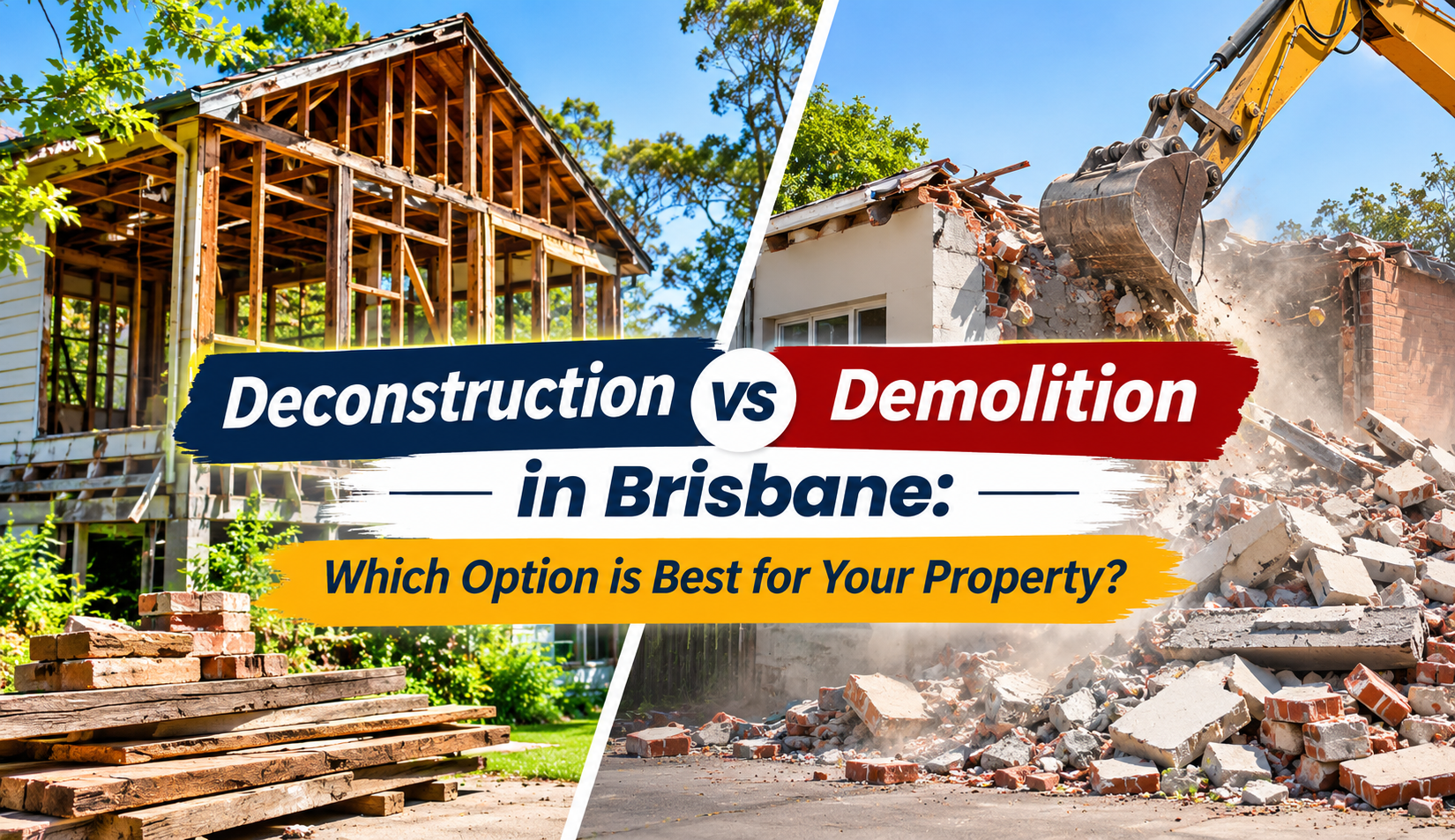
Deconstruction vs Demolition in Brisbane: Which Option Is Best for Your Property?
Choosing between deconstruction and traditional demolition is an important decision when planning to remove an existing building. Whether you own an older home, manage a commercial property or are preparing land for redevelopment, understanding the differences can help you select the right approach.
For Brisbane property owners, factors such as project costs, building materials, site conditions, environmental impact and local approval requirements all play an important role. While traditional demolition is often preferred when a building needs to be removed quickly, deconstruction offers an alternative for projects where recovering and reusing materials is a priority.
Both methods have their advantages, and the right choice depends on your property’s condition, project requirements and future plans.
In this guide, we explain the differences between deconstruction and demolition in Brisbane, their benefits, potential costs and the factors you should consider before starting your project.
What Is Traditional Demolition?
Traditional demolition involves dismantling or bringing down a building using specialised machinery, equipment and controlled methods. The main objective is to remove the existing structure safely and prepare the site for its next stage of development.
Depending on the building’s size and construction, demolition may involve excavators, hydraulic equipment and other machinery to break down walls, roofing, concrete, foundations and structural components.
For many property owners, demolition Brisbane services provide a practical solution when an old, damaged or unwanted building needs to be cleared.
Traditional demolition is commonly used for:
-
Removing old or structurally damaged houses.
-
Clearing residential blocks for new construction.
-
Removing warehouses, factories and commercial buildings.
-
Preparing development sites for redevelopment.
-
Removing concrete structures, driveways and unwanted building elements.
One of the main advantages of traditional demolition is efficiency. Experienced demolition contractors can use suitable machinery and planned work methods to remove large structures within a relatively short timeframe.
However, demolition can generate considerable waste. Materials such as concrete, timber, bricks and metal may need to be separated, transported and processed for recycling or disposal.
What Is Deconstruction?
Deconstruction is a careful and systematic process of taking a building apart, usually in stages. Instead of immediately breaking down the entire structure, workers remove selected components so they can potentially be reused, recycled or recovered.
The process generally begins with an inspection to identify materials that can be salvaged. Depending on the building, this may include timber flooring, doors, windows, roofing materials, bricks, fixtures and fittings.
Unlike conventional demolition, deconstruction Brisbane projects place greater emphasis on recovering usable materials before removing the remaining structure.
Common materials recovered during deconstruction include:
-
Reusable timber beams and flooring.
-
Bricks and masonry.
-
Doors, windows and frames.
-
Roofing materials.
-
Kitchen cabinets and other fittings.
-
Metal components and fixtures.
This approach can help reduce the amount of construction waste sent to landfill while giving suitable building materials another purpose.
However, deconstruction usually requires more planning, manual labour and time than conventional demolition. Not every building is suitable, particularly where materials are damaged, contaminated or difficult to remove safely.
Deconstruction vs Demolition: Key Differences
Although both methods involve removing an existing building, they differ in their approach, labour requirements, waste management and project timelines.
| Comparison factor | Traditional demolition | Deconstruction |
|---|---|---|
| Main purpose | Remove the structure | Carefully dismantle the structure |
| Process | Machinery-based removal | Step-by-step dismantling |
| Time required | Generally faster | Usually takes longer |
| Labour | Greater use of machinery | More manual labour |
| Material recovery | Selected materials may be recovered | Greater focus on material recovery |
| Waste generation | Can generate more mixed waste | Aims to reduce waste |
| Project suitability | Large structures and site clearance | Buildings with reusable materials |
The most suitable method depends on the building’s condition, available budget, project schedule and the amount of material that can realistically be recovered.
House Demolition vs Deconstruction in Brisbane
If you are planning to remove an existing home, you may be considering whether house demolition Brisbane services or a deconstruction approach would be more suitable.
The answer often depends on the property’s age, construction materials and overall condition.
For example, an older Brisbane home with reusable timber flooring, brickwork, windows and architectural features may be suitable for partial or more extensive deconstruction. Recovering these materials could help reduce waste and provide opportunities for reuse.
On the other hand, a severely damaged house, a property with significant structural issues or a site requiring quick preparation for new construction may be better suited to traditional demolition.
Before choosing an approach, consider the following factors:
Age and condition: Older buildings may contain reusable materials, but their condition needs to be assessed before removal.
Structural safety: Damaged or unstable structures may require a controlled demolition approach.
Site accessibility: Narrow driveways, neighbouring properties and limited machinery access can influence the work.
Project timeframe: If construction needs to begin quickly, traditional demolition may be more practical.
Material recovery: Consider whether valuable building materials can be safely removed and reused.
A professional site assessment can help determine whether full demolition, partial deconstruction or a combination of both is appropriate.
Commercial Demolition vs Deconstruction
Commercial properties often present different challenges compared with residential buildings. Warehouses, offices, factories, retail spaces and industrial facilities can contain complex structural elements, specialised equipment and large quantities of construction materials.
Commercial demolition Brisbane projects require careful planning to manage site safety, access, waste removal and surrounding businesses or properties.
Traditional demolition may be the preferred option when an entire commercial structure needs to be removed to make way for redevelopment. It can also be suitable when the building has limited reusable materials or the project has strict completion deadlines.
However, deconstruction may be worth considering when a commercial building contains reusable structural components, metal fittings, doors, partitions or other recoverable materials.
Important considerations for commercial projects include:
-
Building size and structural design.
-
Access for demolition machinery.
-
Nearby businesses, roads and public spaces.
-
Hazardous materials and asbestos assessments.
-
Waste separation and transportation.
-
Project schedules and redevelopment requirements.
For larger projects, the demolition approach should be selected after considering engineering requirements, environmental responsibilities and the property’s intended future use.
Cost Comparison: Is Deconstruction More Expensive Than Demolition?
Cost is one of the biggest considerations for Brisbane property owners. However, there is no single price that applies to every demolition or deconstruction project.
Traditional demolition can be more cost-effective when the primary objective is to remove a structure quickly. Machinery can complete much of the work, reducing the need for extensive manual dismantling.
Deconstruction may involve higher upfront labour costs because workers need to carefully remove, sort and prepare individual materials for recovery.
The overall financial difference depends on several factors.
1. Building size
Larger houses and commercial properties generally require more labour, equipment and waste management. The building’s height, layout and structural design can also affect the project scope.
2. Construction materials
Concrete, brick, steel and timber can require different removal and handling methods. Some materials are easier to recover than others.
3. Site accessibility
Restricted access, nearby structures and difficult ground conditions can increase project complexity and equipment requirements.
4. Hazardous materials
Asbestos identification, removal and disposal can add to project costs. Older Brisbane properties should be assessed for potential hazardous materials before demolition begins.
5. Material recovery
Some recovered materials may have resale or reuse value, depending on their condition and demand. However, this should not be assumed to cover deconstruction costs.
The best way to understand the financial difference is to request a detailed quote that considers both approaches. Compare the scope of work, labour, equipment, waste removal and any potential material recovery value before making a decision.
Environmental Benefits of Sustainable Demolition in Brisbane
The construction and demolition industry generates substantial waste, making responsible material management an important consideration for property owners.
Sustainable demolition Brisbane practices aim to reduce unnecessary waste and improve the recovery of reusable and recyclable materials.
Deconstruction supports this goal by allowing suitable building components to be removed before the remaining structure is demolished.
Some of the key environmental benefits include:
Reduced landfill waste: Recovering suitable materials can reduce the volume of waste sent to landfill.
Material reuse: Timber, bricks, doors and other components may be reused in future building or renovation projects.
Better resource management: Recycling materials such as metals and concrete can reduce the demand for newly sourced resources.
Reduced environmental impact: Responsible waste separation and disposal can help minimise the environmental impact of building removal.
It is important to understand that sustainable practices are not limited to deconstruction. Traditional demolition projects can also incorporate material sorting, recycling and responsible waste management.
The right approach is to choose a contractor who considers waste recovery and environmental responsibilities throughout the project.
Brisbane Demolition Regulations and Approval Requirements
Before starting any building demolition Brisbane project, property owners should understand the relevant local and Queensland requirements.
Brisbane City Council may require building approval before demolition begins. Depending on the property’s location, planning approval may also be necessary.
Additional planning requirements may apply to properties that are:
-
Listed on a heritage register.
-
Identified as local heritage places.
-
Located within the pre-1911 building overlay.
-
Covered by the traditional building character overlay, where applicable.
-
Subject to specific neighbourhood planning requirements.
Some properties in principal or major centre zones may also require additional planning approval for demolition.
Property owners should check their property’s zoning, overlays and relevant approval requirements before arranging demolition work. A licensed building certifier can help determine the approvals required for a particular project.
Another important consideration is asbestos. Older buildings in Brisbane may contain asbestos-containing materials, particularly those constructed before the late 1980s.
Asbestos should be identified and managed before demolition begins. Licensed asbestos removalists must be engaged where applicable licensing requirements apply. Certain demolition activities may also require advance notification to the relevant workplace safety authority.
Taking care of these requirements before work begins helps prevent unnecessary delays and protects workers, neighbouring properties and the surrounding community.
How to Choose the Right Demolition Contractors in Brisbane
Selecting experienced demolition contractors Brisbane property owners can rely on is essential for a safe and well-organised project.
Whether you need to remove a small residential structure or clear a large commercial site, the contractor should understand the specific requirements of your property.
Here are some important factors to consider before making your decision.
1. Check experience and project expertise
Look for contractors with experience handling projects similar to yours. Residential demolition and large-scale commercial demolition can involve different equipment, planning and safety considerations.
2. Confirm licensing and insurance
Check that the contractor holds the relevant licences for the proposed work and has appropriate insurance coverage. Ask for evidence before signing an agreement.
3. Understand the demolition process
A professional contractor should explain how the project will be completed, including site preparation, machinery requirements, safety measures and waste removal.
4. Ask about waste management
Find out how materials will be sorted, recycled and disposed of. If you are interested in deconstruction, ask which materials can realistically be recovered.
5. Request a detailed quotation
A clear quotation should outline the project scope, included services, potential additional costs and estimated timeframe.
Choosing the right contractor can make the entire process more manageable and help ensure your property is prepared for its next stage.
Which Option Is Best for Your Brisbane Property?
There is no universal answer when choosing between deconstruction and traditional demolition. Both approaches offer benefits, and the best option depends on your property’s condition and project objectives.
Consider traditional demolition if:
-
You need to clear the property within a shorter timeframe.
-
The structure is severely damaged or unsuitable for material recovery.
-
You are preparing a residential or commercial site for redevelopment.
-
Machinery-based removal is the most practical approach.
Consider deconstruction if:
-
The building contains valuable reusable materials.
-
You want to prioritise material recovery.
-
Your project allows additional time for careful dismantling.
-
Reducing construction waste is an important consideration.
In some cases, combining both approaches may provide the best outcome. Recovering usable materials first, followed by traditional demolition of the remaining structure, can balance efficiency with responsible waste management.
The best decision should always be based on a professional assessment rather than cost or speed alone.
Final Thoughts
Choosing between deconstruction and demolition is an important part of planning your next property project. While traditional demolition offers an efficient way to clear unwanted structures, deconstruction provides opportunities to recover reusable materials and reduce construction waste.
For Brisbane homeowners, developers and commercial property owners, the right approach depends on the building’s condition, project budget, available timeframe and environmental priorities.
Working with experienced demolition professionals can help you assess your options, understand local requirements and plan the work safely.
If you are planning a residential or commercial property project, take the time to compare both approaches and choose a solution that meets your needs.
Planning a demolition project in Brisbane? Get in touch with a professional demolition team to discuss your property, understand your options and receive a detailed project quotation.
Frequently Asked Questions
1. What is the main difference between deconstruction and demolition?
Traditional demolition focuses on removing a building using machinery and controlled methods. Deconstruction involves carefully dismantling the structure to recover materials that can potentially be reused or recycled.
2. Is deconstruction cheaper than demolition in Brisbane?
Not necessarily. Deconstruction generally requires more manual labour and time, which can increase upfront costs. However, recovering valuable materials may provide some financial benefits depending on their condition and resale value.
3. Do I need council approval for house demolition in Brisbane?
You may need building approval and, depending on your property’s zoning, overlays and heritage status, planning approval. Check the relevant requirements with Brisbane City Council and a licensed building certifier before starting work.
4. Can commercial buildings be deconstructed?
Yes. Commercial buildings can be deconstructed where their structure, materials, safety conditions and project requirements make the process practical. A site assessment is recommended before choosing this approach.
5. How long does a demolition project take?
The timeframe depends on building size, construction materials, site accessibility, approvals and hazardous material requirements. Traditional demolition is generally faster than extensive deconstruction, but every project is different.